Newsletter 19 Januari 2010

New Issue 
Pandemic (H1N1) 2009 - update 83
As of 10 January 2010, worldwide more than 208 countries and overseas territories or communities have reported laboratory confirmed cases of pandemic influenza H1N1 2009, including at least 13554 deaths.
Source: WHO
Read more: http://www.who.int/csr/don/2010_01_15/en/index.html

Asian Partnership on Emerging Infectious Diseases Research (APEIR) The 5th APEIR Regional Meeting
[...] 
Dr Wiku Adisasmito, Indonesia: Policy analysis for pandemic influenza preparedness 
The team set out to understand the generation of policy for stockpiling retroviral drugs for humans and vaccination for poultry. Across the region the first priority is for human health and all countries are stockpiling retroviral drugs as per WHO guidelines, but coverage is constrained by finances. Poultry vaccination policies differ between countries because of economic drivers for poultry industry. Different inter-sectoral strategic interests result in incoherent regional and possibly global health strategies. The team hopes their research will lead to strategies that take into consideration differences in national needs. [...] 
Source: PR Web 
Read more: http://www.prweb.com/releases/IDRC/H5N1/prweb3453404.htm

Research 
Interim Results: Influenza A (H1N1) 2009 Monovalent Vaccination Coverage --- United States, October--December 2009
In July 2009, the Advisory Committee on Immunization Practices (ACIP) issued recommendations for use of the influenza A (H1N1) 2009 monovalent vaccine (1). Recognizing that the vaccine supply would not be ample immediately but would grow over time, ACIP identified 1) initial target groups, consisting of approximately 160 million persons, and 2) a limited vaccine subset of the target groups, initially estimated at 42 million persons (and more recently estimated at 62 million persons), to receive first priority while the 2009 H1N1 vaccine supply was limited (1).

FIGURE. Weekly estimates of influenza A (H1N1) 2009 monovalent vaccination coverage among U.S. residents aged ≥6 months --- National 2009 H1N1 Flu Survey, week ending October 10, 2009, through week ending January 2, 2010Source: CDC 
Read more: http://www.cdc.gov/mmwr/preview/mmwrhtml/mm59e0115a1.htm

Comment
H5N1 Forgotten (Almost), But Not Gone
While the world's flu fighters have concentrated on countering the H1N1 swine flu pandemic, avian influenza H5N1 has quietly continued to take its toll on both poultry and humans. Last year, 17 countries, stretching from Côte d'Ivoire and Germany to China and Japan, reported outbreaks of H5N1 in domestic poultry and wild birds; and the World Health Organization, which still says H5N1 poses a pandemic threat, recorded 72 human cases, 32 of them fatal.
Source: Sciencemag Blog
Read more: http://blogs.sciencemag.org/scienceinsider/2010/01/h5n1-forgotten.html

Risk Communication
National Influenza Vaccination Week: Radio PSAs: I never get the flu 

60 seconds - scripts
Sebelius Announces New Facebook Application Called “I’m a Flu Fighter”
National Influenza Vaccination Week continues with a focus on the importance of young adults getting vaccinated against the H1N1 flu. Today, U.S. Department of Health and Human Services Secretary Kathleen Sebelius will visit Hunter College in New York City for a roundtable discussion with students and faculty about the H1N1 flu. Secretary Sebelius will also announce a new Facebook application called, “I’m a Flu Fighter” that allows users to tell their friends that they received the flu vaccination and urge others to do the same. Source: HHS
Read more: http://www.hhs.gov/news/press/2010pres/01/20100114a.html

Photo

Reuters Pictures
Boonya Klaer-orm, 25, who is 8 months pregnant, receives a H1N1 influenza vaccine shot from a medical staff at a hospital in Nonthaburi province, on the outskirts of Bangkok January 11, 2010. Thailand started the H1N1 vaccination programme on Monday to combat the deadly virus which killed 192 people in the country. Some two million doses of the vaccine were imported from France to be handed out to high-risk groups during the programme, health officials said.
Source: Daylife
Read more: http://www.daylife.com/photo/07VD2NY6padUC?q=h1n1

Quote
"It's still not too late to get vaccinated, and even though we've seen a decrease in hospitalizations and deaths, there could be another wave of H1N1". 
Source: Sacramento Bee
Read more: http://www.sacbee.com/302/story/2463548.html#mi_rss=Sacramento%20County%20News

News Flash

Scientists discover avian influenza outbreak closely related to bird migration
Xinhua
A research jointly conducted by Chinese and Asian scientists has discovered that highly pathogenic avian influenza (H5N1) outbreak was closely related to bird migration. Read more: http://news.xinhuanet.com/english/2010-01/16/content_12822523.htm

Swine flu looms with the return to school
The Australian
HEALTH experts are warning that Australians can expect a second wave of swine flu, possibly as early as the beginning of the school year just a fortnight away.
Read more: http://www.theaustralian.com.au/news/health-science/swine-flu-looms-with-the-return-to-school/story-e6frg8y6-1225820164651

SEAsia to crack down on poultry smuggling to fight H5N1
Reuters
Disease experts in Southeast Asia will map out key poultry smuggling routes, especially along Cambodia's long border with Thailand and Vietnam, in a move to prevent the spread of the H5N1 bird flu virus in the region.
Read more: http://www.reuters.com/article/idUSTRE60E1KH20100115

CDC finds pandemic vaccination gaps in risk groups, health workers
CIDRAP
During a week federal officials set aside to push flu immunization, a new report today reveals that pandemic vaccine uptake is low in two of the top priority groups—those with chronic conditions and healthcare workers.
Read more: http://www.cidrap.umn.edu/cidrap/content/influenza/swineflu/news/jan1510cdc.html

Disclaimer: Newsletter ini hanya merupakan kumpulan dari artikel/liputan/tulisan yang diambil dari berbagai sumber mengenai situasi terkini pandemi influenza di seluruh dunia termasuk Indonesia. Namun demikian isi/ilustrasi/foto tidak mewakili kepentingan atau kebijakan KOMNAS FBPI secara langsung

Newsletter 15 Januari 2010


Photo

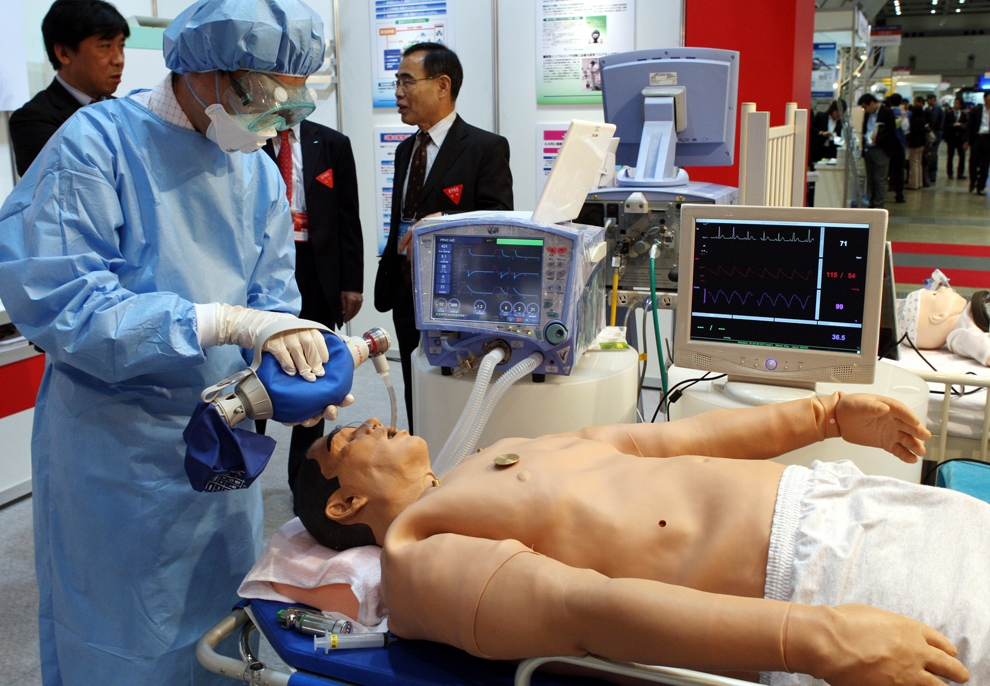
Robot designed to help doctors diagnose H1N1 flu quivers as a man with a full protective outfit puts a tube into its throat during a demonstration at the Security & Safety Trade Expo in Tokyo, Japan, Thursday, Oct. 22, 2009. The life-sized humanoid was developed by Medical Education Technologies, Inc. (METI), the world's leading supplier of human patient simulators, based in Sarasota, Florida, to help medical workers recognize symptoms of the illness and learn to treat patients. It sweats, moans, cries and convulses just like a human would when infected with the H1N1 virus and if the robot is not treated properly the symptoms gradually get worse and it stops breathing. (AP Photo/Koji Sasahara)

Source: Boston

Read more: http://www.boston.com/bigpicture/2009/11/watching_the_h1n1_flu_pandemic.html

New Issue

H1N1 death rates higher for some ethnic and racial groups in California

Latinos, blacks and Native Americans in the state have been more likely to die from swine flue than whites, data show.

By Molly Hennessy-Fiske

California Latinos have been nearly twice as likely as whites to die of H1N1 flu since the pandemic began last spring, according to statewide figures released Thursday by the California Department of Public Health.

Over the same months, blacks in the state have been 50% more likely to die of H1N1 flu than whites, the report said.

Source: LA Times

Read more: http://www.latimes.com/features/health/la-me-h1n1-stats15-2010jan15,0,211614.story

Research

Human, Animal, Ecosystem Health All Key to Curbing Emerging Infectious Diseases

Strategies that integrate human, animal, and environmental health may help prevent outbreaks of zoonotic diseases, such as 2009 influenza A(H1N1), West Nile virus infection, highly pathogenic avian influenza H5N1, and Escherichia coli O157:H7 infection. [...]

Source: American Medical Association

Read more: http://jama.ama-assn.org/cgi/content/full/303/2/117

Comment 

'Kill swine flu without use of chemicals'? Using what -- imagination? 

By Tami Dennis

Note to the easily alarmed: "Chemical-free" does not mean what you think it means.

The term has quite irritatingly become shorthand for "scary compounds we know nothing about and thus must be bad," used to describe whatever a company wants you to think is gentle, benign or guaranteed safe. Enough, I say! As a description of tangible substances, it's wrong. And I want you not to be fooled by it.

Here's an about.com answer to the question What is a chemical? 

"Short answer: Everything is a chemical. Longer answer: Chemistry is the study of matter and its interactions with other matter. Anything made of matter is therefore a chemical. Any liquid, solid, gas. Any pure substance; any mixture. Water is a chemical. Technically speaking, so is a chunk of your computer." Oxygen? A chemical element. Water? A combination of the chemical elements hydrogen and oxygen. The human body? A whole passel of chemicals -- naturally occurring ones, no less.

There's more, but that's probably enough for today. If not, here's a fun site, chem4kids.com. Don't be chastened by the name. The very friendly home page does state that "it's for everyone."

As for the "kill swine flu without use of chemicals" reference, it's from a pitch for a product that uses tap water.

Source: LA Times

Read more: http://latimesblogs.latimes.com/booster_shots/2010/01/kill-swine-flu-chemical-free-chemistry-lesson.html

Risk Communication

FDA 2010 H1N1 (Swine) Flu Page

The FDA plays a vital role on the team led by the U.S. Department of Health and Human Services in the fight against the 2009 H1N1 virus. The agency works closely with the Centers for Disease Control and Prevention, National Institutes of Health, other federal government agencies, and global partners such as the World Health Organization and foreign governments to protect public health during the 2009 H1N1 pandemic.

Source: FDA

Read more: http://www.fda.gov/NewsEvents/PublicHealthFocus/ucm150305.htm

Quote

"My fears are people have truly lost interest in H1N1," said Frank Welch, medical director for pandemic preparedness in Louisiana.Thousands of high-risk kids missing 2nd H1N1 flu doses
Source: USA Today

Read more: http://www.usatoday.com/news/health/2010-01-14-H1N1-swine-flu-booster-children_N.htm

News Flash

Claims H1N1 is a fake pandemic are scientifically wrong and irresponsible: WHO

The Canadian Press

The perception has led to low uptake of H1N1 vaccine in many countries that had pre-purchase orders. A number of western European countries have announced ...

Read More: http://www.google.com/hostednews/canadianpress/article/ALeqM5jFxM_0oyB5RPbXsZ5GLIYpBaNqrw

China issues swine flu travel warning for Lunar New Year

AFP

China's health ministry has urged vulnerable groups to get swine flu vaccinations or limit travel during the upcoming Chinese Lunar New Year ...

Read more: http://www.google.com/hostednews/afp/article/ALeqM5gIXLXr-YzdG-d6VXKE8_FsCS4LLg

Swine Flu Caused Permanent Lung Damage in Some

YLE

Swine flu has caused permanent pulmonary damage to some patients in Finland. In Kuopio, five people who were in intensive care with the H1N1 virus developed serious lung problems.
Read more: http://yle.fi/uutiset/news/2010/01/swine_flu_caused_permanent_lung_damage_in_some_1367397.html

Glaxo becomes swine flu victimStuff

As the biggest gainer from the H1N1 swine flu pandemic, GlaxoSmithKline now has most to lose as countries cut back their orders.

Read more: http://www.stuff.co.nz/business/world/3232361/Glaxo-becomes-swine-flu-victim

New ionator EXP(TM) and ionator HOM(TM) Kill Swine Flu Without Use of Chemicals

Sunherald

Revolutionary Water-Based Handheld Devices Clean and Leave No Chemical Residue; ionator EXP(TM) and ionator HOM(TM) Eliminate 2009 Pandemic H1N1 Influenza A Virus in Seconds

Read more: http://www.sunherald.com/457/story/1864511.html

Disclaimer: Newsletter ini hanya merupakan kumpulan dari artikel/liputan/tulisan yang diambil dari berbagai sumber mengenai situasi terkini pandemi influenza di seluruh dunia termasuk Indonesia. Namun demikian isi/ilustrasi/foto tidak mewakili kepentingan atau kebijakan KOMNAS FBPI secara langsung
Newsletter 14 Januari 2010

New Issue
An efficient formal synthesis of oseltamivir phosphate (Tamiflu) has been achieved in 12 steps with use of the inexpensive and highly abundant d-ribose as the starting material. This concise alternative route does not utilize protecting groups and features the introduction of 3-pentylidene ketal as the latent 3-pentyl ether, the use of a highly efficient RCM reaction to form the Tamiflu skeleton, and selective functional group manipulations. [...]
Source: American Chemical Society

Genetic analyses of avian influenza in wild birds can help pinpoint likely carrier species and geographic hot spots where Eurasian viruses would be most likely to enter North America, according to new research.
Source: ScienceDaily: Bird Flu Research News
Read more: http://www.sciencedaily.com/releases/2010/01/100112123644.htm


Research

Influenza A Pandemic (H1N1) 2009 Virus Infection in Domestic Cat

Influenza A pandemic (H1N1) 2009 virus continues to rapidly spread worldwide. In 2009, pandemic
(H1N1) 2009 infection in a domestic cat from Iowa was diagnosed by a novel PCR assay that
distinguishes between Eurasian and North American pandemic (H1N1) 2009 virus matrix genes. Human-
to-cat transmission is presumed. [...]
Source: CDC
Read more: http://www.cdc.gov/eid/content/16/3/pdfs/09-1737.pdf (download)


Comment

WHO prepares to don a hair shirt

The finger pointing and the told-you-so-ers are out in force these days and WHO seems to be one of their targets. In the face of wealthy European countries cutting their swine flu vaccine orders because of limited demand, critics are claiming that WHO exaggerated the threat in league with or under the influence of Big Pharma vaccine makers out to make a killing. This is really two issues. One, did WHO appropriately appraise the risk; and two, were they unduly influenced by greedy drug makers. I think the answer to these questions are "Yes" and "No." [...]

Source: Science Blogs

Read more: http://scienceblogs.com/effectmeasure/2010/01/who_prepares_to_don_a_hair_shi.php


Risk Communication

Weekly government briefings about swine flu have been abandoned, a signal that the crisis is considered to be easing.
Figures show the number of new cases in England has fallen dramatically over the past month - from 9,000 over a week in December to under 5,000 last week.
The Department of Health said the briefings would be scrapped until there were any fresh developments.
It said it would now use fortnightly bulletins to keep journalists up-to-date with statistical trends.[...]
Source: BBC
Read more: http://news.bbc.co.uk/2/hi/uk_news/8458333.stm?


Photo

AP PHOTO
IONATOR EXP KILLS SWINE FLU IN SECONDS, CHEMICAL-FREE - converts water into a powerful cleaner/sanitizer.
Source: Daylife
Read more: http://www.daylife.com/photo/0faD2zKcL36ht?q=Swine+Flu


Quote

"Comparisons of deaths from pandemic and seasonal influenza do not accurately measure the impact of the pandemic for another reason. Compared with seasonal influenza, the H1N1 virus affects a much younger age group". [...]

Source: Irish Times

Read more: http://www.irishtimes.com/newspaper/ireland/2010/0114/1224262291929.html


News Flash

2 swine flu virus mutations found
news.gov.hk
The Centre for Health Protection has detected two more human swine flu virus strains with mutations similar to the one Norway reported last year...
Read more: http://www.news.gov.hk/en/category/healthandcommunity/100112/txt/100112en05008.htm

Europe Cancels H1N1 Shots as Flu Fails to Heat Up
Wall Street Journal
Just months after rushing to order enough swine-flu vaccine to protect their citizens, European governments are ...
Read more: http://online.wsj.com/article/SB126335633266727463.html?mod=WSJ_business_IndustryNews_DHC
Poland stands alone in refusing swine flu vaccines
Washington Post
AP WARSAW, Poland -- The decision seemed fraught with risk: a government refusing to import swine flu vaccines amid worldwide warnings of a ...
Read more: http://www.washingtonpost.com/wp-dyn/content/article/2010/01/13/AR2010011300770.html
Vietnam Airlines 2009 profit falls 42 percent
AFP
The carrier also cited "epidemic outbreaks" for its profit fall, an apparent reference to the global A (H1N1) swine flu pandemic. But VNA noted it had still ...
Read more: http://www.google.com/hostednews/afp/article/ALeqM5i1cVqFY2tqxuumah8I-CNegWNJEA